Infinity-Filter plugin
Forward real player IPs to your backend using the Infinity-Filter forwarding plugin.
The Infinity-Filter forwarding plugin is an alternative to the PROXY protocol for forwarding real player IPs from the edge to your backend. The two are mutually exclusive — pick one.
When to use the plugin
- Your proxy software doesn’t have a clean PROXY protocol implementation.
- You’re integrating with a stack that already expects an Infinity-Filter token (legacy migrations).
- You want a per-network token-based mechanism for auditability.
Where to download it
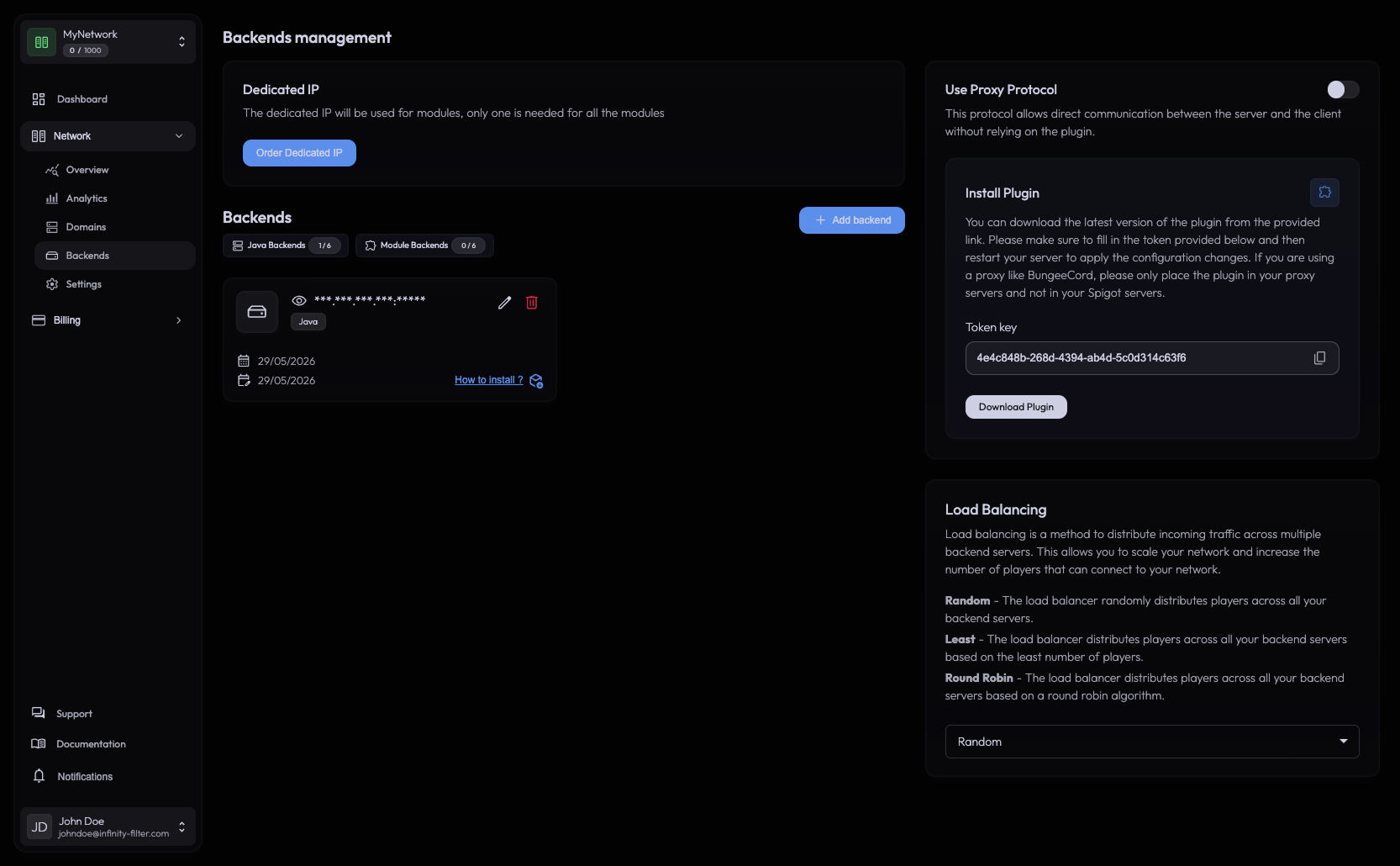
Open Network → Backends. With the PROXY protocol toggle off, the right-hand panel shows:
- A Download Forward plugin button.
- A per-network token to paste into the plugin’s config.
Installing the plugin
- 1
Download
Click Download Forward plugin in the panel. You get a single JAR.
- 2
Drop the JAR
Drop the JAR into the
plugins/folder of every backend (or every proxy) that should receive forwarded IPs.For most setups: drop it on the Velocity / BungeeCord proxy that sits in front of your Spigot servers.
- 3
Configure the token
Start the server once so the plugin generates its config. Open the config file and paste the token shown in the panel.
For standalone Geyser setups, also enable Geyser support:
token: "{paste-the-token-from-the-panel}" allow-external-connections: true geyser-support: true - 4
Restart
Restart the proxy / backend. From this point on, the plugin reads the real player IP from the custom header Infinity-Filter sends with each connection.
What you must NOT do
Per-network token
The token is per network. If you have multiple networks, each has its own token in its own Backends page. If you reuse a backend across multiple networks (rare), each network’s plugin instance needs its own token.
Why we recommend PROXY protocol instead
PROXY protocol is:
- Standardised — implemented by HAProxy, nginx, Velocity, BungeeCord and most reverse proxies natively.
- Plugin-free — no extra JAR to install, update, or break on a Minecraft version bump.
- Wire-level — the header is part of the TCP stream, so it works regardless of the application-layer protocol.
The plugin is functionally equivalent for real-IP forwarding but adds an extra moving part. If you have no constraint, prefer PROXY protocol.
What’s next
Last updated: May 28, 2026